Some Lake District fungi & a slime mould – July 2025
During the summer I was a volunteer helper for my daughter’s DofE expeditions and the practice expedition was in the Lake District based in Hawkeshead. On a walk to Grizedale forest and back, descending from Carron Crag I stumbled upon some Arcyria cinerea at various stages of development.

Grizedale Forest – 25th July 2025
From globular primordia to elongated sporangia at various stages of maturity – translucent pale clay-pink and grey to bluish-grey and dark bluish-grey.

Grizedale Forest – 25th July 2025

Grizedale Forest – 25th July 2025
The salmon-pinkish mass looks like it could be plasmodium. In his identification handbook, Bruce Ing states that Arcyria cinerea plasmodium, while white, usually develops
a pinkish tinge before the sporangia are fully formed. [1]

Grizedale Forest – 25th July 2025

Grizedale Forest – 25th July 2025

Grizedale Forest – 25th July 2025

Grizedale Forest – 25th July 2025

Grizedale Forest – 25th July 2025
Based on my photos, the colour change appears to progress as follows: starting at the bottom of the sporotheca, the clay‑pink hue turns dark bluish‑grey, then the bluish‑grey spreads upward, producing a sporotheca with distinctive dark bluish‑grey tips. The final colour stage before dehiscence is a uniform bluish‑grey.
Further along the path, heading towards Grizedale, I noticed a patch of possible false chanterelles — Hygrophoropsis aurantiaca.

Near Grizedale – 25th July 2025

Near Grizedale – 25th July 2025
However when I fed a photo into Mykokey’s identification AI it ID’d it as a Chanterelle — Cantharellus cibarius [2]. At First Nature’s Cantharellus cibarius page there is a photo and a description of the “gills”:
Not strictly gills at all, the wrinkled veins on the underside of the cap distinguish the golden (as some people call it) chanterelle from lookalikes such as Hygrophoropsis aurantiaca, the False Chanterelle. [3]
I don’t think that these gills are wrinkled.

Near Grizedale – 25th July 2025
First Nature’s page on the False Chanterelle states that:
The cap margin usually remains slightly inrolled [4]
…which these fungi appear to have.
In the afternoon, walking through New South Wales Plantation to the south east of Grizedale, I was horrified to spot what I thought was a mouldy dog poo 😠
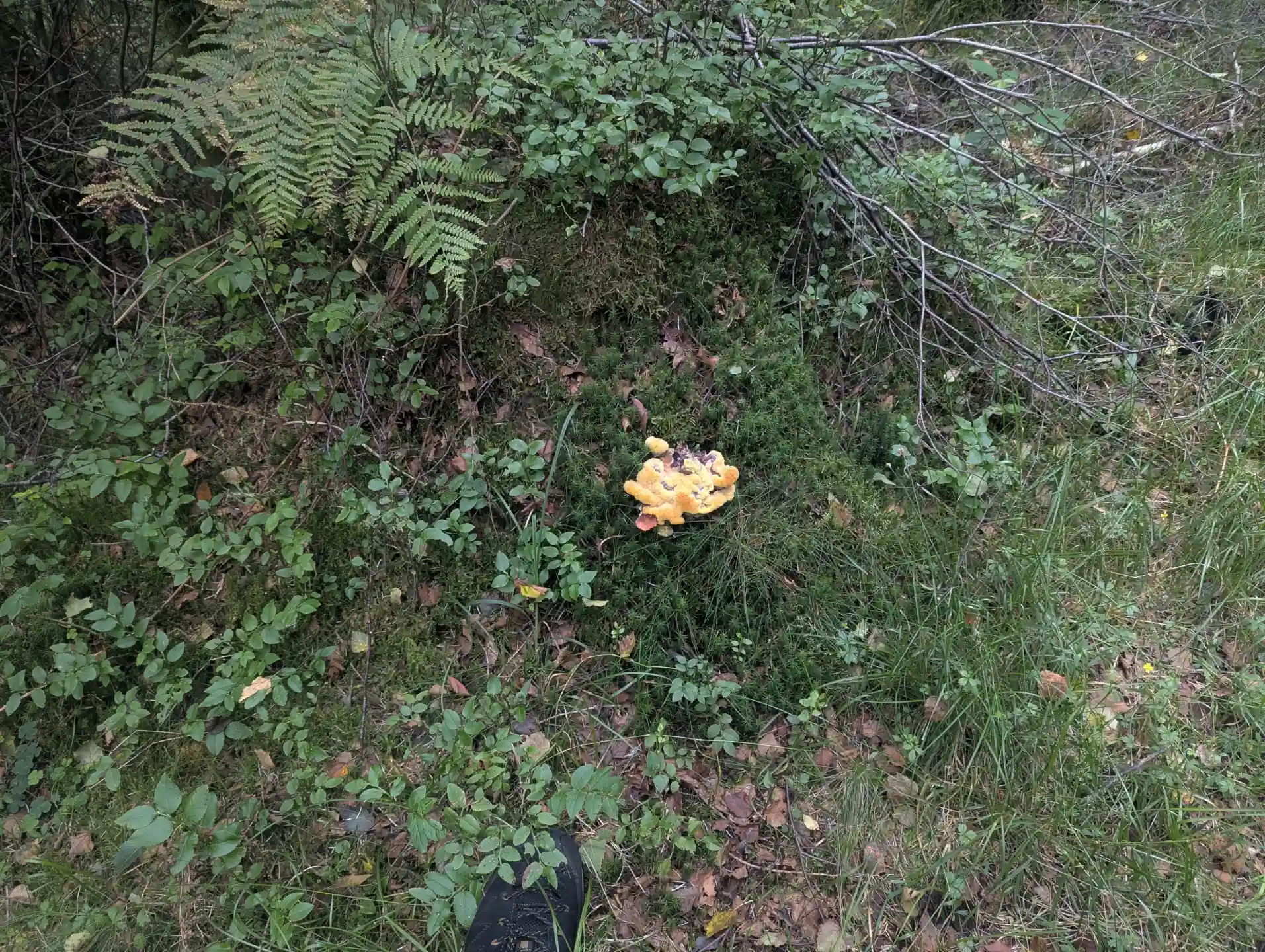
Grizedale Forest – 25th July 2025
But it was a Dyer’s Mazegill – Phaeolus schweinitzii ! which I had never seen before.
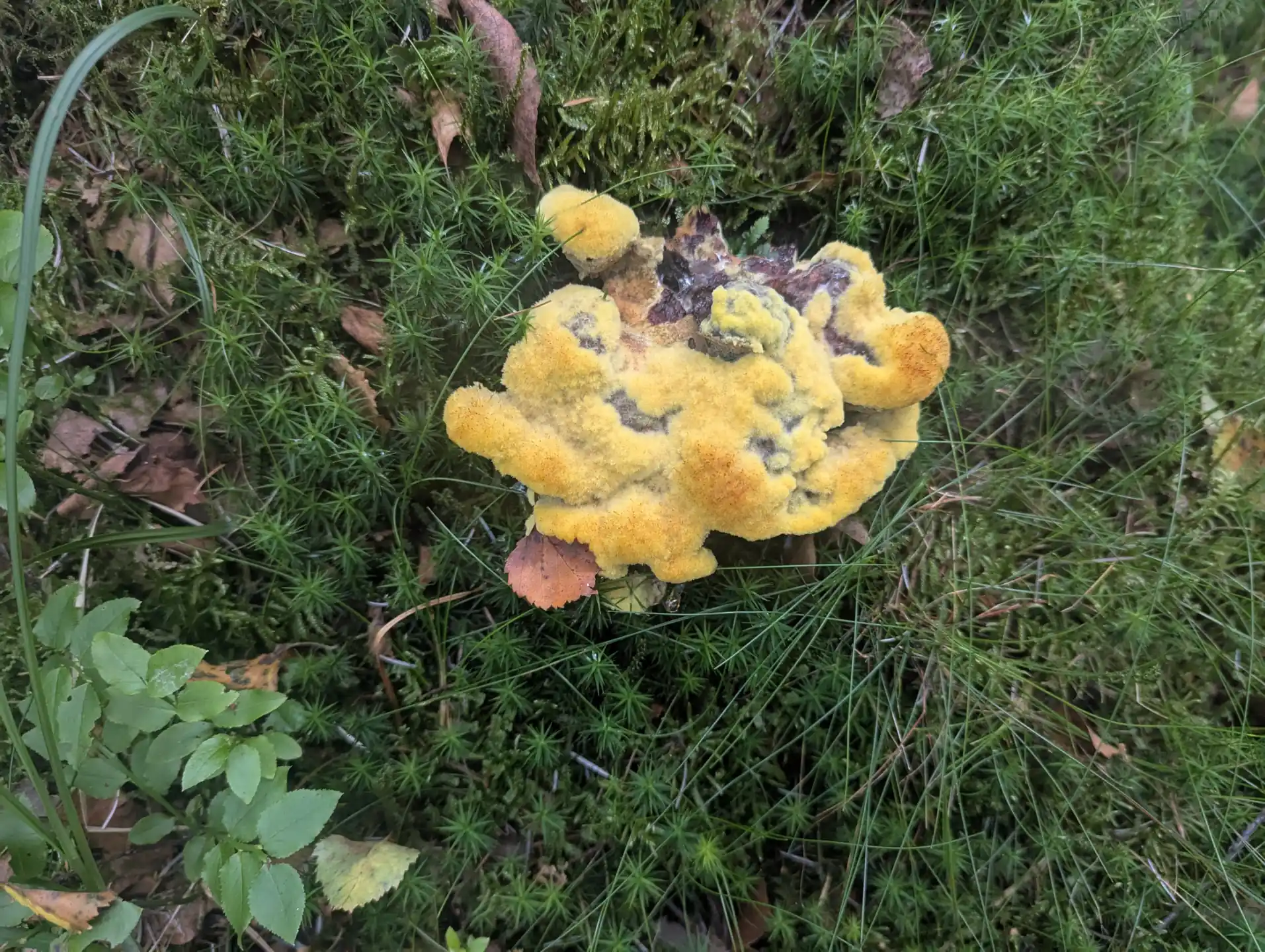
Grizedale Forest – 25th July 2025
It was the damaged furry surface exposing a gooey brown mess that made me think it was something unpleasant.
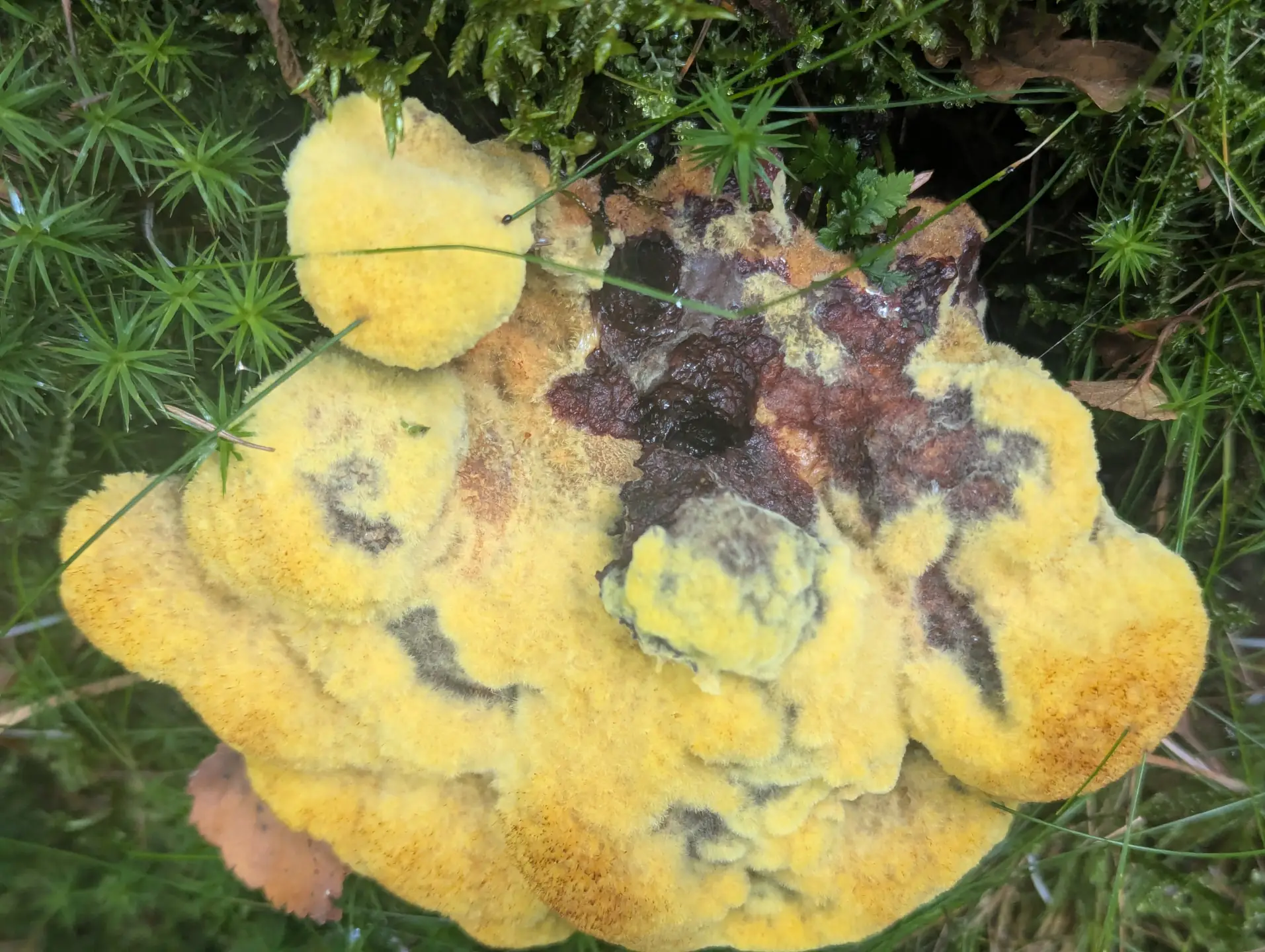
Grizedale Forest – 25th July 2025
Such a wonderful short furry texture.
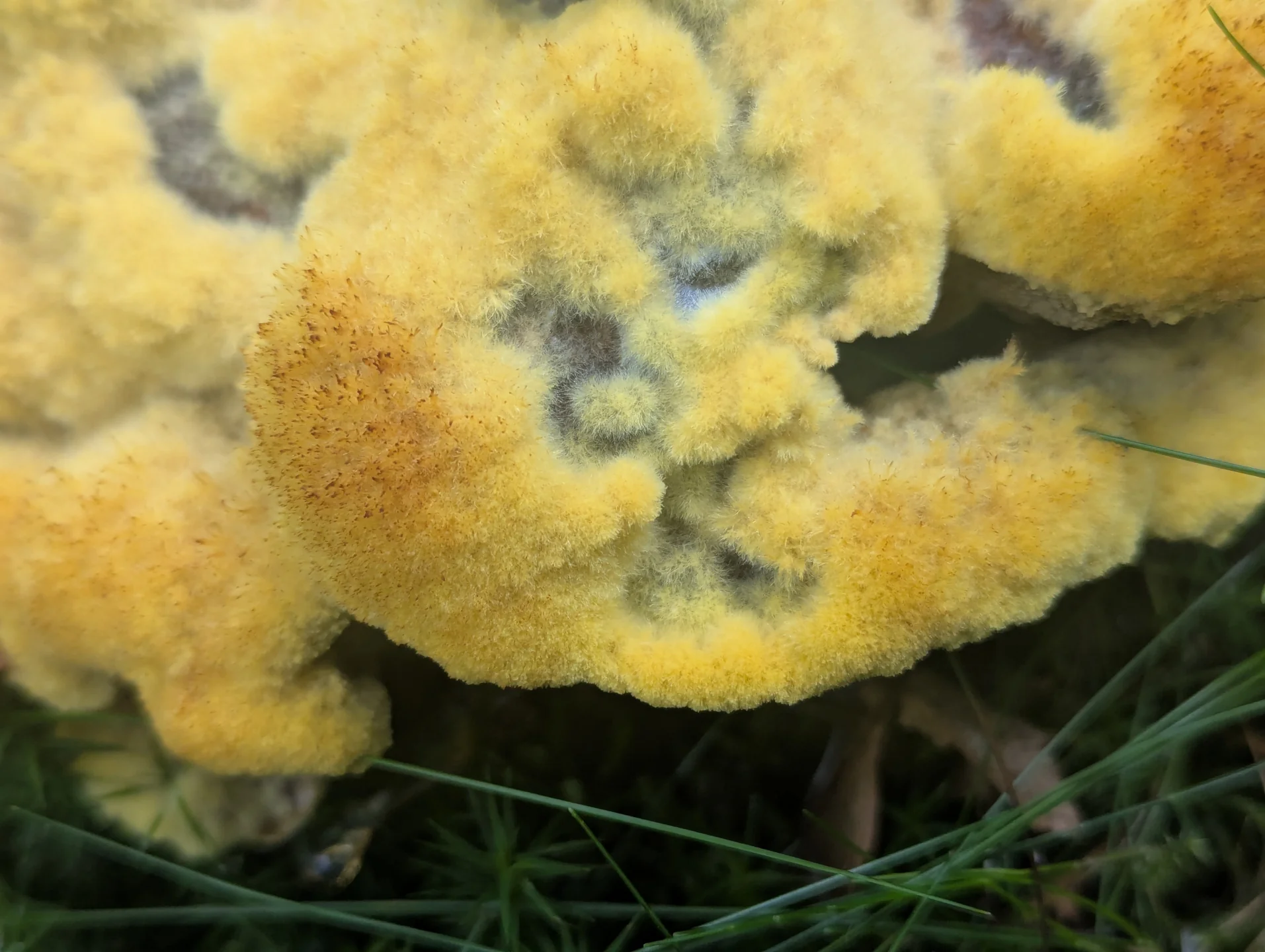
Grizedale Forest – 25th July 2025
Further along the trail I came across a second furry fungus – another Dyer’s Mazegill. Seeing this one and noting it’s similarity with the first one above, reassured me that they were both the same fungus.

Grizedale Forest – 25th July 2025
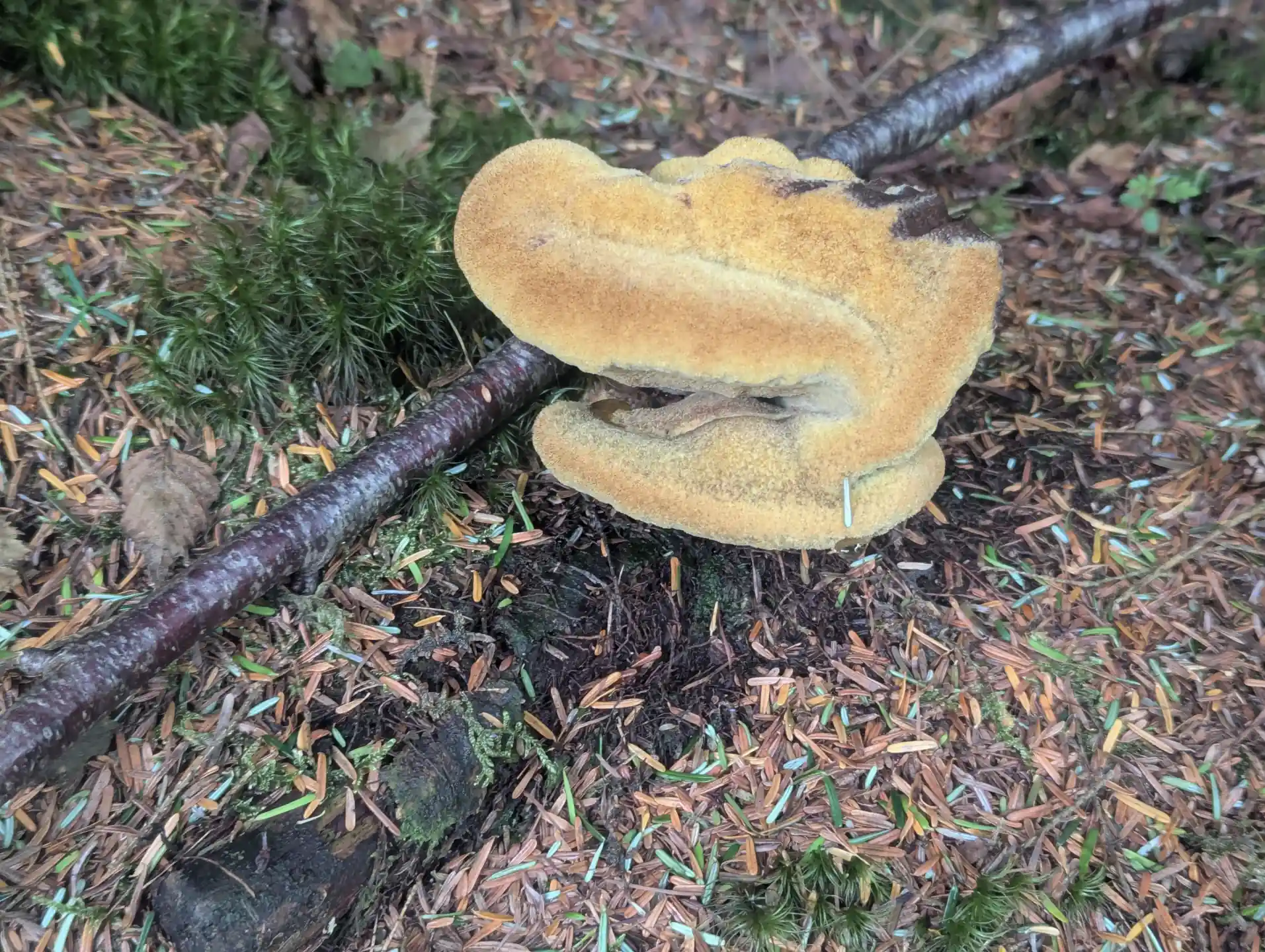
Grizedale Forest – 25th July 2025
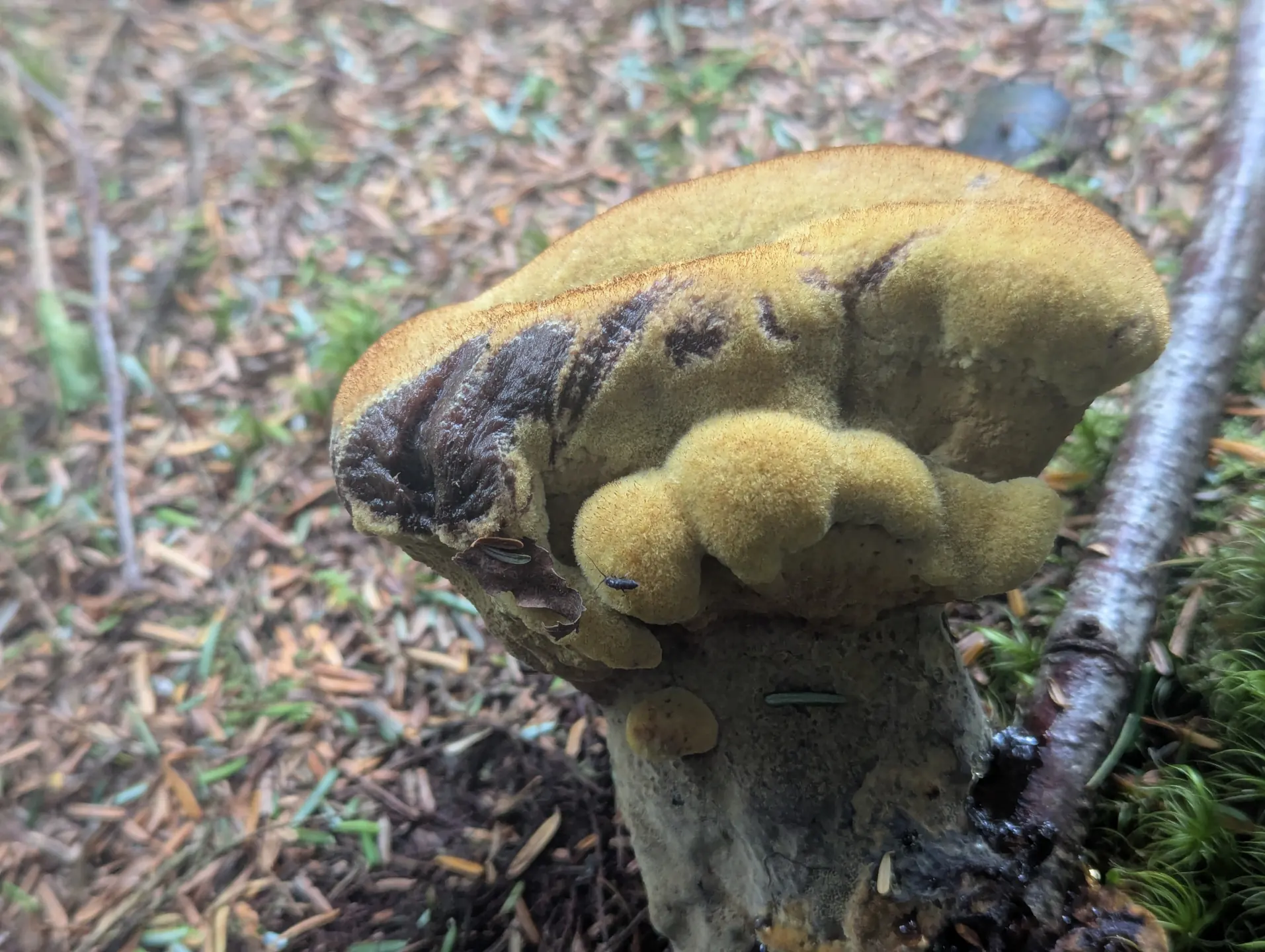
Grizedale Forest – 25th July 2025
Notice the liquid oozing out of the bottom of the stem.
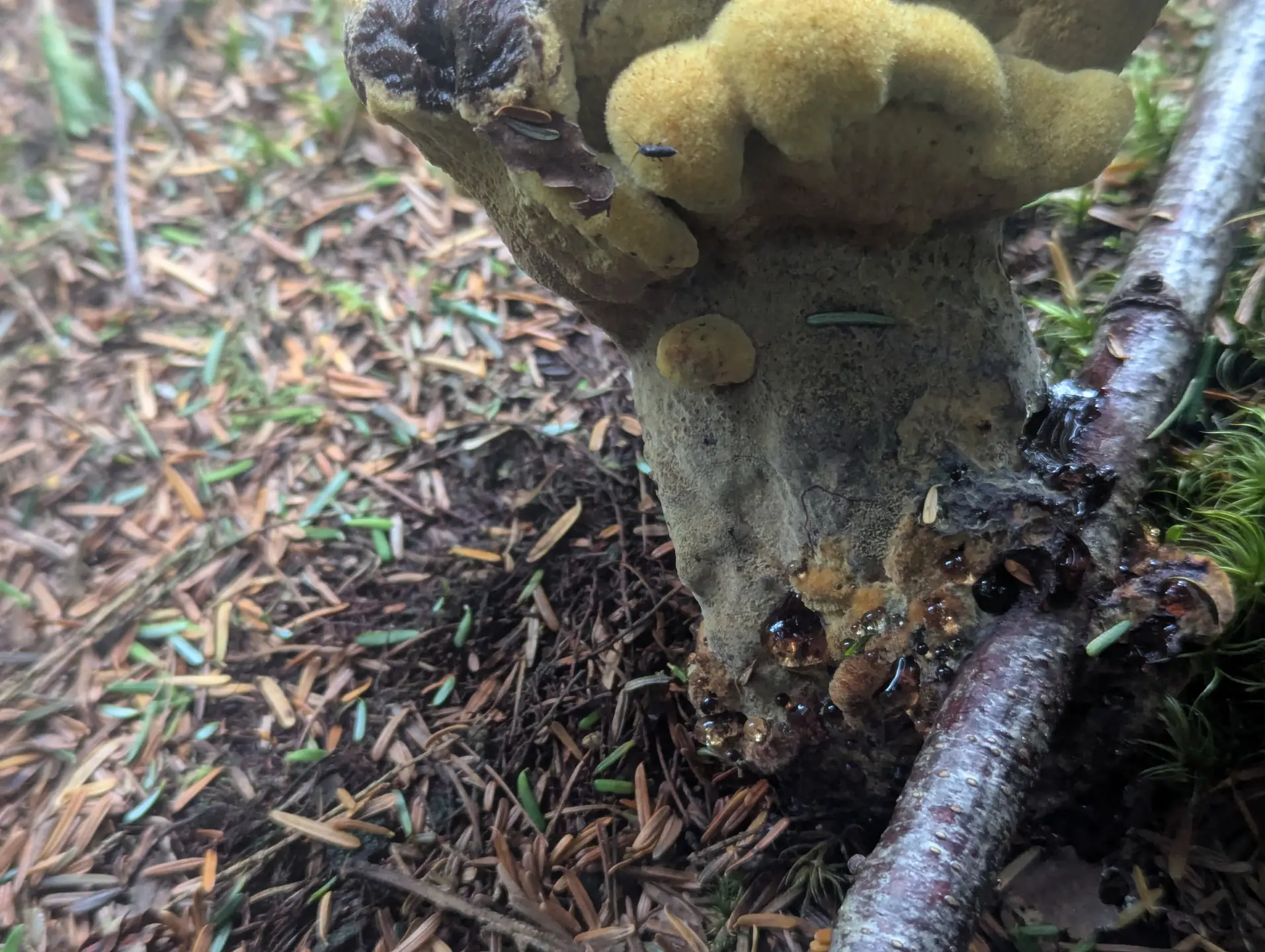
Grizedale Forest – 25th July 2025
Near Grizedale Tarn I spotter a Blusher – Amanita rubescens.

Grizedale Forest – 25th July 2025

Grizedale Forest – 25th July 2025
On the way back to Hawkeshead, at Furness Fells, I stopped by a log stack for a rest. In cup at the cut end of a log, growing out of a thin detritus layer, were some small, translucent orange-red fan shaped fungi.
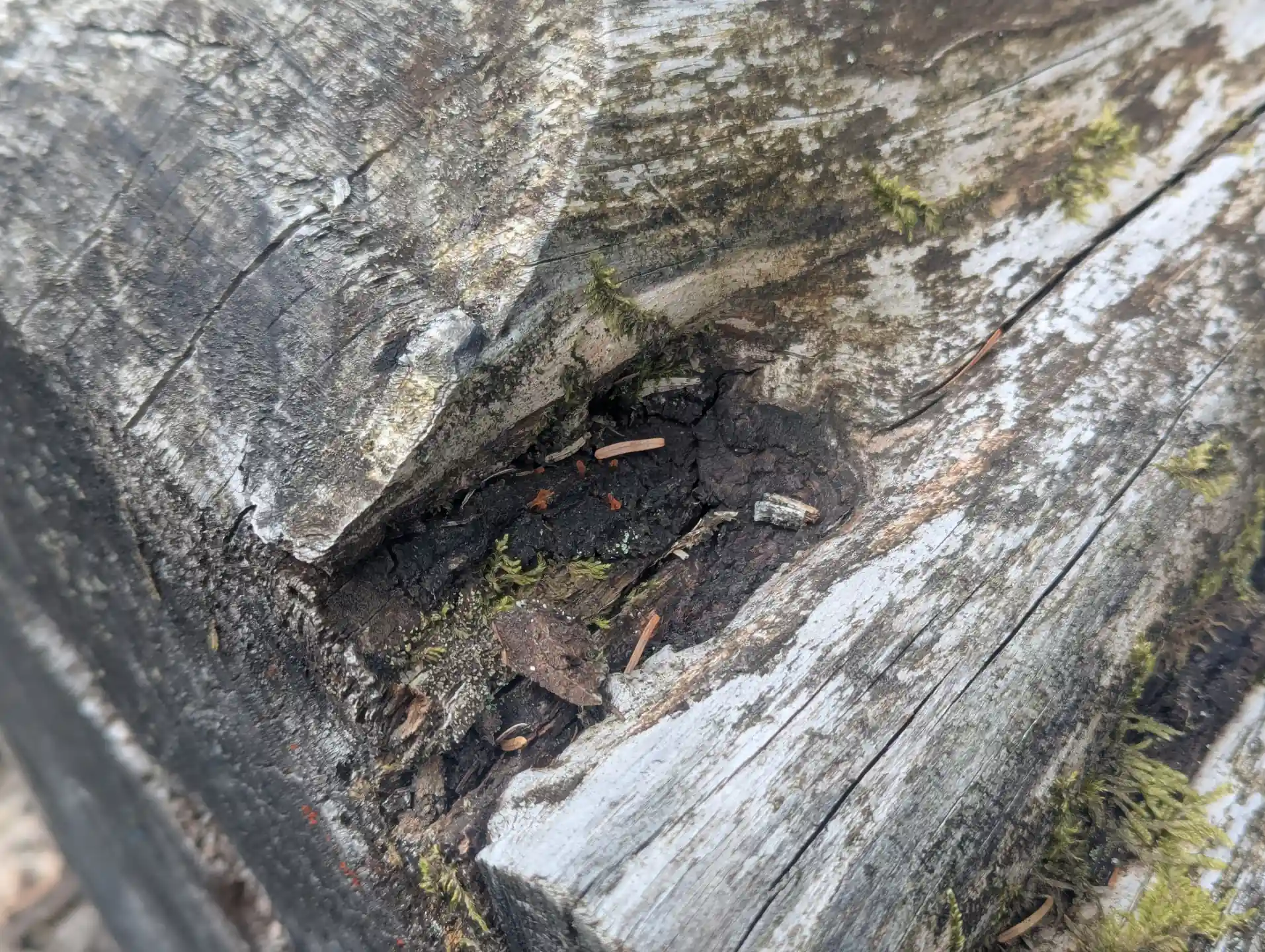
Grizedale Forest – 25th July 2025
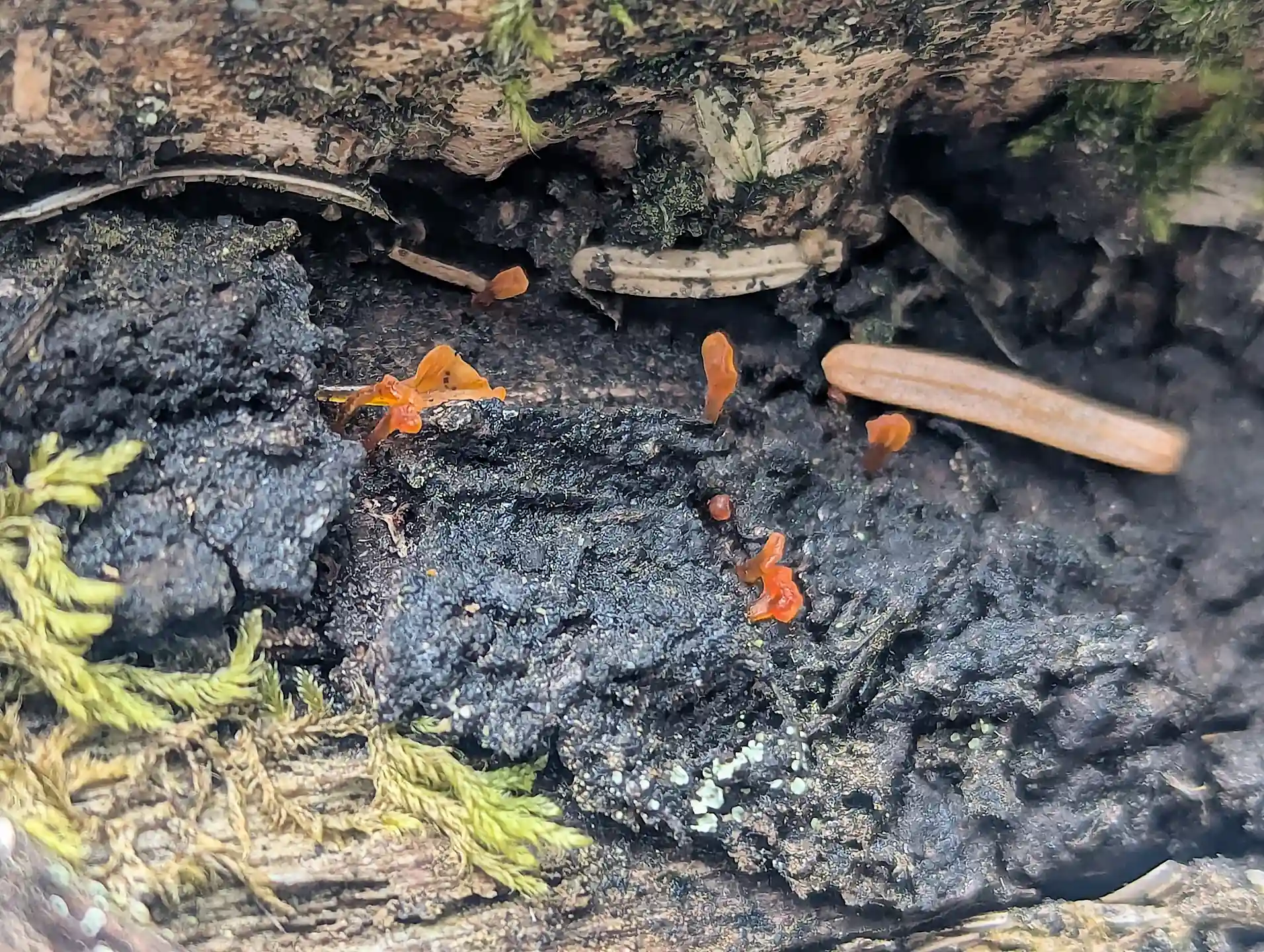
Grizedale Forest – 25th July 2025
I’m wondering if these are Dacrymyces spathularia. Wikipedia, however, states that this fungus is “not known from Europe” [5]. But, the source for this is from a 1965 publication by McNabb [6] where he states
“…D. spathlilaria, which occurs throughout the world with the exception of Europe…”
That’s 60 years ago!
So could these be Dacrymyces chrysospermus? First Nature states that Dacrymyces chrysospermus is very rarely recorded in Britain [7].
Although the photos of Dacrymyces chrysospermus at First Nature somewhat resemble my find, I think my find – for what it’s worth – overall more closely matches the photos of Dacrymyces spathularia [8] than those of Dacrymyces chrysospermus [9] at iNaturalist.
Having said that, at iNaturalist, there are two apparent observations of Dacrymyces spathularia in the UK that remain unverified.
In any case, with these two very similar species the comparison relies entirely on visual matching, and unverified (or even verified) iNaturalist observations – including the two UK reports of Dacrymyces spathularia – are often based on tentative photographic identifications.
[1] The Myxomycetes of Britain and Ireland – Bruce Ing.
[2] MycoKey’s identification AI
[3] First Nature’s Cantharellus cibarius page.
[4] First Nature’s Hygrophoropsis aurantiaca page.
[5] Dacrymyces spathularia at Wikipedia
[6] McNabb 1965 publication – https://www.tandfonline.com/doi/epdf/10.1080/0028825X.1965.10432062
[7] Dacrymyces chrysospermus at First Nature